

For over 30 years, Fircroft Technologies has provided audible and visual alarm systems tailored to education settings, from schools to universities. Its solutions meet strict fire safety standards while remaining simple to use for staff.
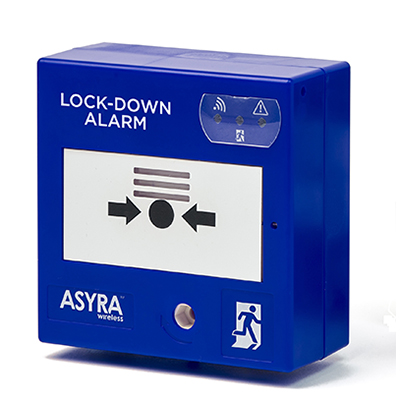 The ASYRA Wireless platform enables these alerts on a single wireless system, monitored via a mobile app, reducing cabling and disruption. Ideal for busy campuses, it offers fast installation, scalability, and integrated safety management. Operating independently off Wi-Fi or internet, it ensures reliable performance when it matters most.
We spoke with Kieron Chapman, Managing Director at Fircroft Technologies, to explore why the ASYRA Wireless platform is particularly well suited to the education sector. Discussing how the company is tailoring its solutions to meet the distinct safety challenges faced by schools and campuses, Kieron explained, “We have taken our extensive experience of designing premium specification fire alarm audible and visual signalling products and applied it to developing a lockdown alarm suitable for schools. We originally focussed on one of our export markets where lockdown legislation was introduced before in the UK. Then, with Martyn’s Law progressing, we enhanced the product range to deliver a solution for the UK public sector. As cost is critical for Public Sector budgets, we focussed on using our high output devices to reduce the number of devices required on a system compared to other solutions. This has a big impact on costs. By taking our proven technology and modifying tones and flash colours to ensure they are different from normal fire alarm tones and flash colours to avoid confusion, we have a simple, secure and affordable Lockdown alarm solution.”
 With increasing focus on both fire safety and lockdown procedures in education, Kieron then explained how the ASYRA wireless system supports multi-scenario emergency response, “We strongly believe that while our ASYRA wireless system can be added to an existing fire alarm system to provide a comprehensive Lockdown alarm solution, the preferred solution is to keep them as separate systems. If one system developed a fault or was vandalised during a risk scenario, we would not want both systems to be affected. Aswell as that, a fire system by law should take priory to any other function it provides, so, a scenario where an intruder entered the building and activated a call point could cause a conflicting event and increase risk. If, after a risk assessment, the client requires a combined system solution, the ASYRA system can do this with simple, ‘Fail Safe’ I/O modules to interface inputs and outputs.”
When asked how their systems help ensure faster alarm activation and safer evacuation or lockdown procedures, Kieron said, “With the ASYRA system being wireless, and us having weather proof versions of the lockdown activation devices, we can position them at the most suitable locations for early alarm activation. This may be near a car park or entrance to a school or even in the playing field areas. The earlier the alarm is initiated; the sooner staff and pupils get to safety. On top of that, we have a wireless communications protocol that reacts quickly meaning that on the typical system it is 3-5 seconds between triggering a device and signalling being seen and heard. Some other systems take considerably longer to react.”
One resounding complication in the education sector is that most buildings are very old, and different educational environments require different needs from an alarm system. In response to this, Kieron explained how the system can adapt to all environments and buildings, “Being wireless, there is no cabling required. We recently had an ASYRA system installed in a school of 1,500 pupils in four man-days from start to finish, and by working before and after school hours for testing, the disruption was minimal. Every wireless solution has to cater for reduced coverage when dense construction materials or site layout demands. The ASYRA system has a wonderfully simplistic way to scale system sizes.”
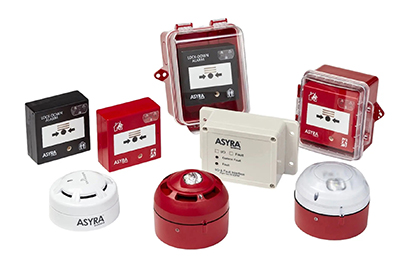 “Each call point can be set as a ‘Master’ device enabling up to 254 other devices of any type to be connected to it. If, due to the site characteristics, additional wireless coverage is required, simply create additional zones with more master call points. Each Master call point communications hub becomes a zone on the system. Each of these zones are then linked together to make one system by using a special function in the I/O modules. It is best practice to determine coverage and zoning requirements before starting the installation and this can be done with a site survey using the link verification mode built into the products.”
Finally, we asked Kieron what innovations he sees shaping the future of fire and safety systems in the education sector, “Innovations in the technology tend to take time due to extensive approvals processes on fire systems. There are updates on government guidance being introduced regularly in this sector. We expect that, in time, there will be new standards created that apply to lockdown alarms and other systems also. We are members on trade associations and hope to be involved in that process. We believe that while providing standards and recommendations for a safety critical solution, we should keep the wide variety of customer application needs in mind to ensure that the solution for each client and site is safe, secure, fit for purpose, installed to a high standard and remains affordable.”
For more information, please see below:
T 01873 821550
sales@fircrofttech.com
www.fircrofttech.com
www.asyrawireless.com