

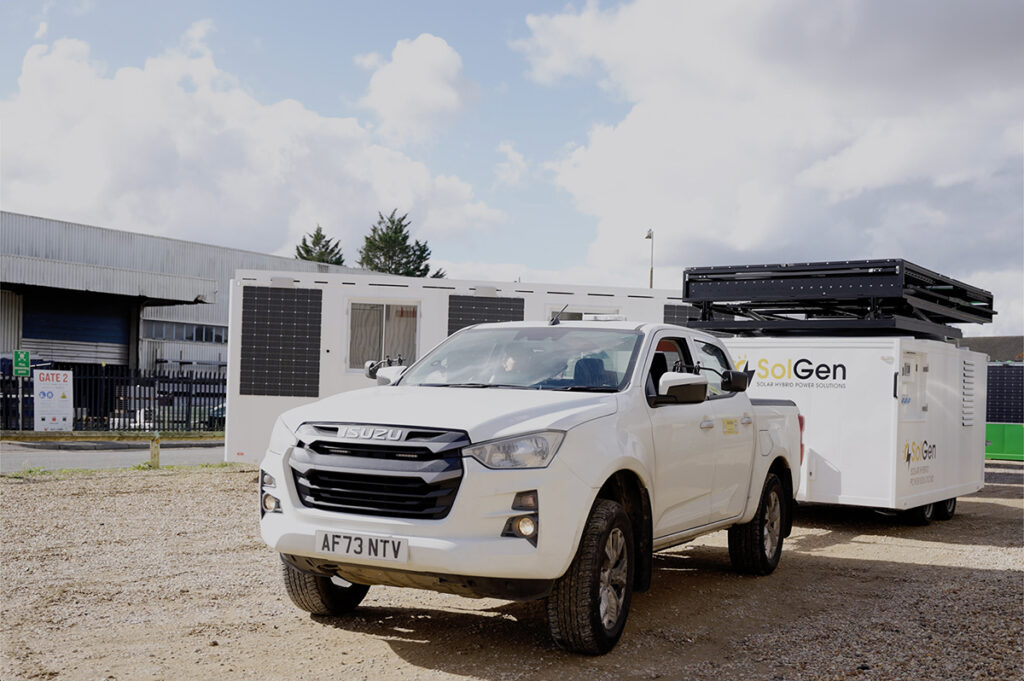
Across construction, infrastructure and temporary works, the expectations placed on site power have shifted. Cost remains critical, but so do noise constraints, emissions targets, ESG reporting requirements and the practical reality that many locations simply do not suit constant generator running. In that context, the conversation is moving from ‘how do we power this site?’ to ‘how do we power it efficiently, quietly and with provable outcomes?’
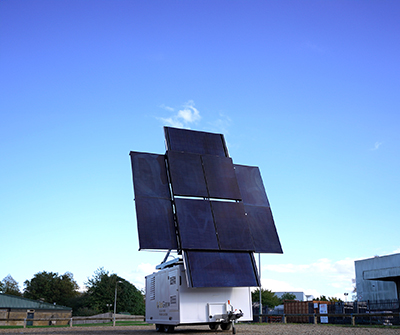 Hybridisation is the clearest step-change. By combining solar generation, lithium battery storage and an intelligent backup generator in one integrated system, modern hybrid power reduces fuel burn without compromising uptime. The key point is operational control: when the system is genuinely ‘solar-first’ and demand-matched, the generator becomes an occasional support asset rather than a 24/7 necessity. The result is fewer refuelling visits, reduced maintenance exposure, lower noise and immediate cost impact.
At SolGen, the focus has been on building a mobile, off-grid solution that maximises renewable contribution in real conditions, not only in idealised demonstrations. Our ‘Sunflower’ tracking approach is designed to harvest more energy than fixed arrays by automatically optimising panel pitch and direction as the sun angle changes, with bifacial technology to further increase capture. In practical terms, this can materially increase solar yield compared with static systems, and that yield directly translates into reduced generator runtime and fuel consumption.
 For many sites, the economics are now difficult to ignore. When this power system can cut fuel costs by up to £1,000 per week versus a traditional diesel generator setup, while also enabling substantial carbon reduction, hybrid power becomes a commercial decision as much as a sustainability one. SolGen systems are built to generate the reporting that procurement teams and ESG leads increasingly need: remote monitoring, real-time and historical performance data, fuel and CO2 saving outputs, and exportable reporting for audits and sustainability submissions.
The direction of travel is clear. Sites that adopt intelligent hybrid power early are not only reducing emissions; they are stabilising operating costs, improving working conditions, and de-risking compliance. The future of temporary off-grid power will be defined by systems that deliver measurable outcomes, automatically, day after day.
T 01778 300394
sales@solgenpower.co.uk
www.solgenpower.co.uk